
Every South Indian home I grew up around started the day the same way. Sweep the threshold. Draw the kolam. Light the lamp. Nobody called it a “morning routine.” Nobody bought a planner for it, we managed to observe and make do with irukaradhe vecchindu (found) objects. It was simply Dina, the daily turn of the wheel, and everything else in the day was built on top of it.
In the US, My sketchbook became my kolam.
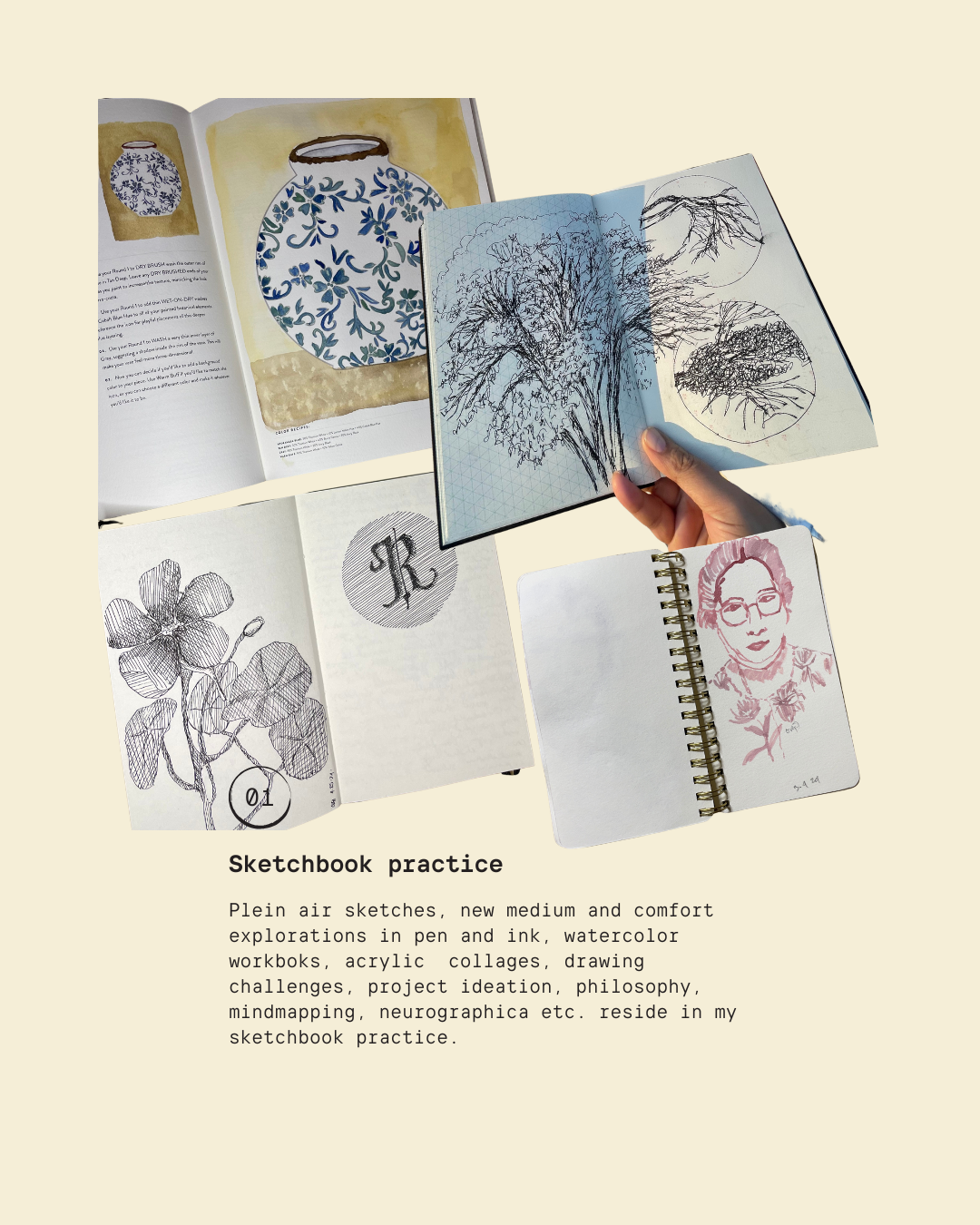
Before I paint a Tanjore panel, grid out a Ganesha by Shilpa Shastra proportion, or curate a library Golu, there is the sketchbook. Plein air trees in pen and ink. A blue-and-white vase from a watercolour workbook. A cross-hatched flower that took three coffees. A monogram R, because sometimes you just need to sign your own name loudly. A quick portrait in rose pink. Mind maps, neurographica, half-formed project ideas, and a fair amount of philosophy scribbled sideways in the margins.

It looks scattered. It isn’t. It’s a system.
Planner’s insight:
In fifteen years of reviewing development applications, I learned that the plans which survive are never the prettiest ones. They’re the ones with a clear base layer. Zoning, setbacks, the boring grid. Get the base right and everything layered on top has somewhere to stand.
The sketchbook is my base layer. Daily, low-stakes, non-negotiable. It is where ideas get their first site visit before anything gets entitled to become a commission, a print or a product.
And then the architect in me takes over Look closely at that tree sketch. It sits on isometric grid paper. Architecture school trained me to see that grid everywhere, and I’ve stopped fighting it. The tree is organic, wild, unruly. The grid underneath is quiet and orderly. That tension, nature on top of structure, is what I chase in all of my work. It is also, frankly, what good urban design is: a street grid that lets a neighbourhood grow its own personality.
What project management taught my sketchbook
- Small daily outputs beat heroic weekend sprints. Ten minutes of pen and ink compounds faster than one guilty Sunday marathon.
- The sketchbook is my backlog. Every idea gets logged. Not every idea gets built. That’s not failure, that’s prioritisation.
- Test before you invest. New medium? It goes in the sketchbook first, not on the A2 sheet of expensive paper.
- Retrospectives are built in. Flip back three months and you can see exactly where your line got braver.
When you move countries, you lose a lot of your daily scaffolding. The temple bell down the street. The flower seller who knew your mother. The rhythm. For a while in America, my days had deadlines but no ritual. The sketchbook gave it back. Irukkaradha vechu, with whatever I had: one pen, one notebook, one stolen half hour before the house woke up. My Bay Area morning now has a threshold again.
(Also, no one in America tells you that a sketchbook in a coffee shop makes strangers assume you’re either a genius or an undercover inspector. I let them wonder.)
Why Dina, why now?
This post opens a series on the two rhythms that run my creative life: Dina, the daily, and Ritu, the seasonal. Over the next five weeks I’ll walk you through iconometry, colour, teaching and community curation, all leading to the finale on December 15. Dina is the inner circle. She moves fast. Everything else orbits around her.
Your turn
Start your own Dina. One page, today. It doesn’t have to be good. It has to be done.
Join my newsletter and I’ll send you my free Monkey Mask template as a welcome gift, a small ritual to make with your hands this week.
Leave a Reply